Clifton Grove
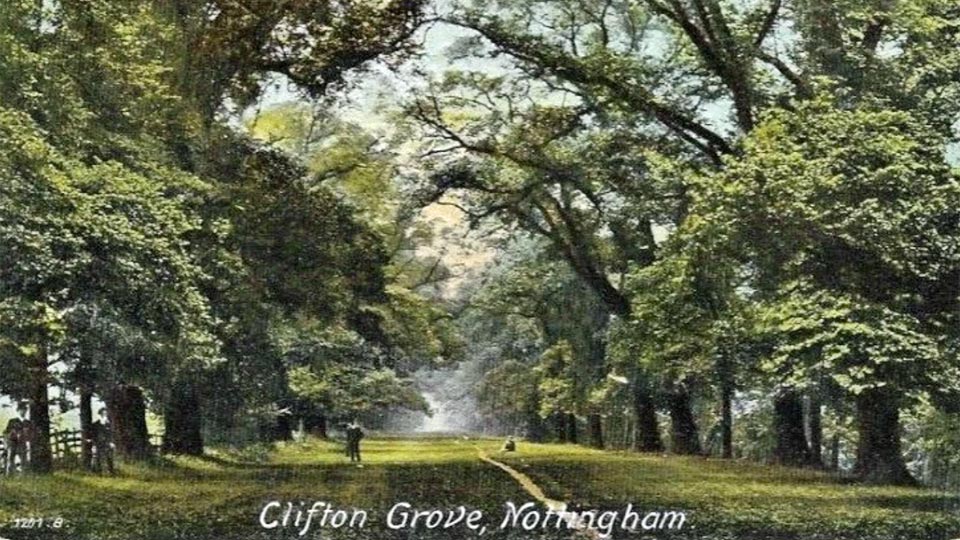
Clifton Grove is a peaceful woodland stretching for around two miles (3½ km) from Clifton Bridge along the cliff on the east bank of the River Trent. A dense green canopy covers the entire cliff face, with a riverside path running along its base. At the summit, a broad grassy lane is lined with an orderly row of trees on each side.
The cliff has long acted as a natural barrier between Clifton and the Trent, protecting the community from the river’s historic flooding. To the south, the Grove merges seamlessly into Clifton Wood, extending this overlooked retreat by a further kilometre and forming one of Nottingham’s most forgotten green spaces.
Origin
The Grove was planted in 1677 by Sir William Clifton to create a grand avenue of elm trees leading to Clifton Hall. Visitors travelled the full length of the avenue, beginning at a small stone bridge over Fairham Brook and ascending the gentle slope of the cliff before arriving at the Hall gates. Although the original bridge collapsed in 1910, it was quickly replaced and still serves today as a pedestrian entrance to the Grove.
Through the ages
Attempts by the Clifton family to restrict public access ultimately failed, and by the 19th century the Grove had become Nottingham’s most popular rural escape. Its appeal continued well into the 20th century. Shaw’s Guide to Nottingham (1874) vividly records how, at Easter and Whitsuntide, thousands of Nottingham artisans and their families flocked to the Grove, whether courting, socialising or simply enjoying the open air.
In Barker’s Walks Around Nottingham, the author notes the many initials and dates carved into the bark of the avenue trees, recording human stories stretching back centuries. One carving, dated 1754, was among the oldest he could trace.
Modern times
Urban expansion has inevitably threatened the Grove’s character. Even in the mid-1800s it must have felt remarkable countryside so close to the town. Industrial development following the opening of Clifton Colliery in 1871 paved the way for further growth, although playing fields along the west bank of the Trent have helped preserve a green buffer. Clifton Bridge, carrying the A52 across the river, remains a visual intrusion, but young trees and shrubs along the path have gradually softened its impact.
Clifton has expanded dramatically since the 1940s, growing into a large housing estate of around 30,000 people. Modern housing and university buildings now press up to the treeline, diminishing the Grove’s sense of separation from urban life. The loss of the ancient elms to Dutch elm disease in the 1970s was a major blow, though replanting continues and future generations will restore some of the former splendour.
Despite these changes, Clifton Grove remains a tranquil and rewarding place to explore. While it no longer draws the crowds of earlier centuries, it is well used by locals for dog walking, cycling, fishing and seasonal activities, with canoes and rowing boats regularly passing along the Trent
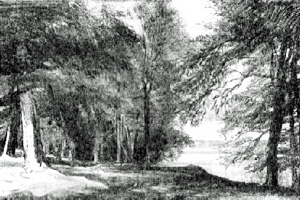
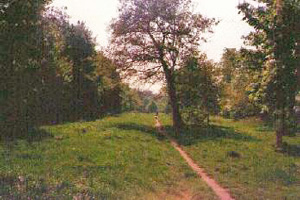
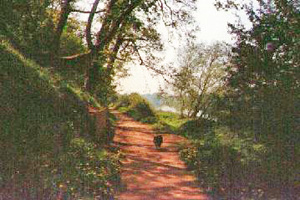
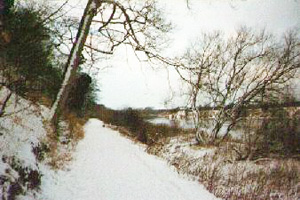
Images of Clifton Grove through the years
The legend of Clifton Grove
Legend has it that a young squire in the service of Sir Gervase Clifton and a maiden of Clifton fell in love just before the Battle of Bosworth in 1485.
The maiden gave the squire half a gold piece as a token of her love and pledged to wait for his return when they would marry. She retained the other half of the gold coin as her own memento of love
The squire followed William Clifton to fight in France. Eventually he returned to marry his beloved only to find the maiden had broken her promise and married a wealthy local man. He is then said to have killed himself by plunging into the Trent in despair.
The guilt-ridden maiden was soon after dragged into the river by a demon at the great 'chasm' in the grove below Clifton Hall. The Nottingham poet, Henry Kirke White wrote the poem called 'Clifton Grove ' that has a number of verses devoted to the legend.
Material on this web page based on "Wilford & Clifton Index" (1997) by Roy Mat.